Cart
0
Yemeni Wildflower Honey is a polyfloral honey produced when bees collect nectar from multiple wildflowers in Yemen. Its main distinction from single-flower honey is its diverse floral source, which can create a complex aroma, flavor and texture that varies by harvest and region.
Authentic Yemeni Wildflower Honey is valued for its raw character, distinctive floral profile, Yemeni origin and traditional harvesting practices. This guide explains what Yemeni Wildflower Honey is, how it tastes, its common uses, how it differs from Sidr honey, how to assess authenticity, and why some Yemeni honey products command premium prices.
What Is Yemeni Wildflower Honey?
Yemeni Wildflower Honey is a polyfloral honey, meaning bees collect nectar from multiple flowering plants rather than predominantly from one botanical source. The honey's color, aroma, flavor and texture can vary depending on the flowers available during the harvest, the region and seasonal conditions.
Unlike Yemeni Sidr Honey, which is associated primarily with nectar from the Sidr tree, wildflower honey reflects a broader mix of floral sources. This gives Yemeni Wildflower Honey its distinctive multifloral character.

Yemeni Wildflower Honey at a Glance
| Feature | Yemeni Wildflower Honey |
|---|---|
| Honey type | Polyfloral / wildflower |
| Origin | Yemen |
| Floral source | Multiple flowering plants |
| Flavor | Floral, aromatic and naturally sweet |
| Texture | Can range from smooth and viscous to naturally crystallized |
| Color | Varies from light to darker amber depending on floral source |
| Common uses | Tea, yogurt, toast, desserts and culinary recipes |
| Main distinction | Multifloral origin and variable seasonal character |
| Compared with Sidr | Wildflower uses multiple floral sources; Sidr is associated primarily with the Sidr tree |
How to Check if Yemeni Wildflower Honey Is Authentic
There is no single home test that can reliably prove whether honey is authentic. Instead, evaluate several indicators together:
1. Check the country and region of origin
Look for specific sourcing information rather than a vague "Yemeni honey" label.
2. Look for batch or laboratory documentation
Where available, independent laboratory testing can provide stronger evidence than visual appearance alone.
3. Check the ingredient list
Pure honey should list honey as the ingredient rather than added syrups, flavors or other sweeteners.
4. Evaluate the seller's transparency
A reputable seller should be able to explain where the honey comes from and how it is handled.
5. Don't rely on viral home tests
Water, flame, thumb and similar home tests cannot reliably establish honey authenticity.
What Does Yemeni Wildflower Honey Taste Like?
Yemeni Wildflower Honey typically has a floral, aromatic and naturally sweet flavor, although the exact profile varies according to the flowers available during the harvest and the region where the honey is produced.
Depending on the batch, you may notice:
- Floral sweetness
- Herbal or earthy notes
- Warm caramel-like notes
- A lingering natural finish
This variation is one of the defining characteristics of polyfloral honey.
How to Use Yemeni Wildflower Honey
| Use | How to Use It |
|---|---|
| Tea | Stir into warm tea |
| Breakfast | Drizzle over yogurt, oats or toast |
| Desserts | Use as a natural sweetener |
| Smoothies | Add a small amount for sweetness |
| Cheese | Pair with soft or aged cheeses |
| Salad dressing | Combine with lemon and olive oil |
| Traditional drinks | Add to warm beverages |
Is Yemeni Wildflower Honey Good?
Yemeni Wildflower Honey can be a good choice for people who enjoy naturally sweet foods with a distinctive floral flavor and want to explore honey with a specific geographic origin. Its appeal comes primarily from its multifloral character, flavor, provenance and traditional production rather than from claims that it can treat or prevent disease.
For everyday use, it can be added to tea, yogurt, breakfast foods, desserts and savory dishes. Buyers interested in premium honey should also consider sourcing transparency, processing method and laboratory documentation.
Yemeni Wildflower Honey: Potential Benefits
Raw wildflower honey has been used in traditional Yemeni and wider Arabian medicine for centuries. Modern nutritional research has begun to validate what these traditions long understood: raw, unprocessed honey from diverse floral sources is a nutritionally rich food with a broad range of potential wellness applications.
Naturally Occurring Antioxidant Compounds
Honey naturally contains various phenolic compounds and antioxidants. Their amount and composition can vary depending on floral source, geography and processing. For this reason, the nutritional profile of wildflower honey can differ between harvests.
A Natural Source of Carbohydrates
Honey contains naturally occurring glucose and fructose, making it an energy-containing food. It can be used as a natural sweetener in tea, yogurt, breakfast foods and recipes.
Traditional Throat Use
Honey has a long history of traditional use for soothing the throat. It is commonly added to warm drinks or consumed by itself. Honey should not be presented as a treatment for medical conditions.
Part of a Balanced Diet
Like other added sugars, honey should be consumed in moderation. Its main dietary advantage is its flavor and versatility rather than being a substitute for medical treatment.
Why Is Yemeni Wildflower Honey Expensive?
Yemeni Wildflower Honey can command a premium price because of its origin, limited harvest volumes, sourcing conditions, transportation requirements and the costs associated with authentic raw honey production. Seasonal availability and supply-chain traceability can also affect the final price.
Price alone, however, does not prove authenticity. Buyers should look for clear origin information, transparent sourcing and appropriate purity or laboratory documentation where available.
| Factor | Why It Can Affect Price |
|---|---|
| Yemeni origin | Sourcing and transportation costs |
| Seasonal harvest | Supply can vary |
| Traditional production | More labor-intensive sourcing |
| Limited availability | Smaller supply can increase cost |
| Testing & traceability | Quality verification adds cost |
How to Identify Real Yemeni Wildflower Honey
The premium reputation of Yemeni honey has, unfortunately, made it a target for counterfeiters. Knowing what to look for protects your investment and ensures you are receiving the real benefits.
What Labels to Look For
Look for suppliers who are transparent about origin, specific region, not just "Yemen." Reputable suppliers will mention their sourcing relationships with named beekeepers or cooperatives, provide batch testing results, and clearly state that the product is raw and unfiltered. Vague labels like "pure honey" or "natural honey" without substantiation mean very little.
Common Myths About Crystallization
Many buyers return honey because it has crystallized, believing it has gone bad. This is one of the most widespread honey myths. Crystallization is a natural physical process that occurs in honey with high glucose content, exactly the honey you want. To reliquefy crystallized honey, simply place the jar in warm (not hot) water. The honey will return to its liquid state without losing any of its properties.
Who Should Use Yemeni Wildflower Honey?
The short answer is: almost everyone. But there are specific groups for whom Yemeni Wildflower Honey is particularly well-suited.
Health-Conscious Individuals
If you are mindful about what goes into your body, reading ingredient labels, avoiding unnecessary additives, and choosing nutrient-dense foods, then authentic raw honey is a natural fit. It is one of the few sweeteners that actually adds nutritional value rather than simply adding empty calories.
Natural Food Lovers and Culinary Enthusiasts
Yemeni Wildflower Honey is a genuinely exceptional ingredient. Drizzled over labneh and walnuts, stirred into Yemeni tea, paired with artisan cheeses, or used to finish a slow-braised lamb dish, it adds a depth of flavor that processed honey simply cannot match. Chefs and food lovers who care about provenance and taste quickly become loyal to it.
Those Building Daily Wellness Routines
Many wellness practitioners and nutrition-conscious households use raw honey as a functional daily food, replacing refined sugar in teas and smoothies, using it as a natural throat soother during the cold season, or incorporating it into a morning ritual with warm water and lemon.
Premium Gift Buyers
Authentic Yemeni Wildflower Honey, particularly when presented in artisan packaging, makes an extraordinarily thoughtful gift. It communicates care, knowledge, and a genuine appreciation for rarity, far more meaningful than a generic chocolate box.
Yemeni Sidr Honey vs Yemeni Wildflower Honey
| Feature | Yemeni Wildflower Honey | Yemeni Sidr Honey |
|---|---|---|
| Floral source | Multiple flowering plants | Primarily associated with Sidr blossoms |
| Honey type | Polyfloral | Monofloral / predominantly single-source |
| Flavor | Floral and varied | Rich, distinctive and robust |
| Harvest character | Changes with season and floral sources | Closely associated with Sidr flowering |
| Best suited for | Multifloral flavor and everyday gourmet use | Consumers seeking a distinctive Sidr profile |
| Origin | Yemen | Yemen |
In simple terms: choose Yemeni Wildflower Honey when you want a multifloral honey profile; choose Yemeni Sidr Honey when you specifically want the distinctive character associated with Sidr blossoms.
Where to Buy Yemeni Wildflower Honey in the UAE
If you are looking for Yemeni Wildflower Honey in the UAE, check the product's origin, processing method, available documentation and seller transparency before purchasing.
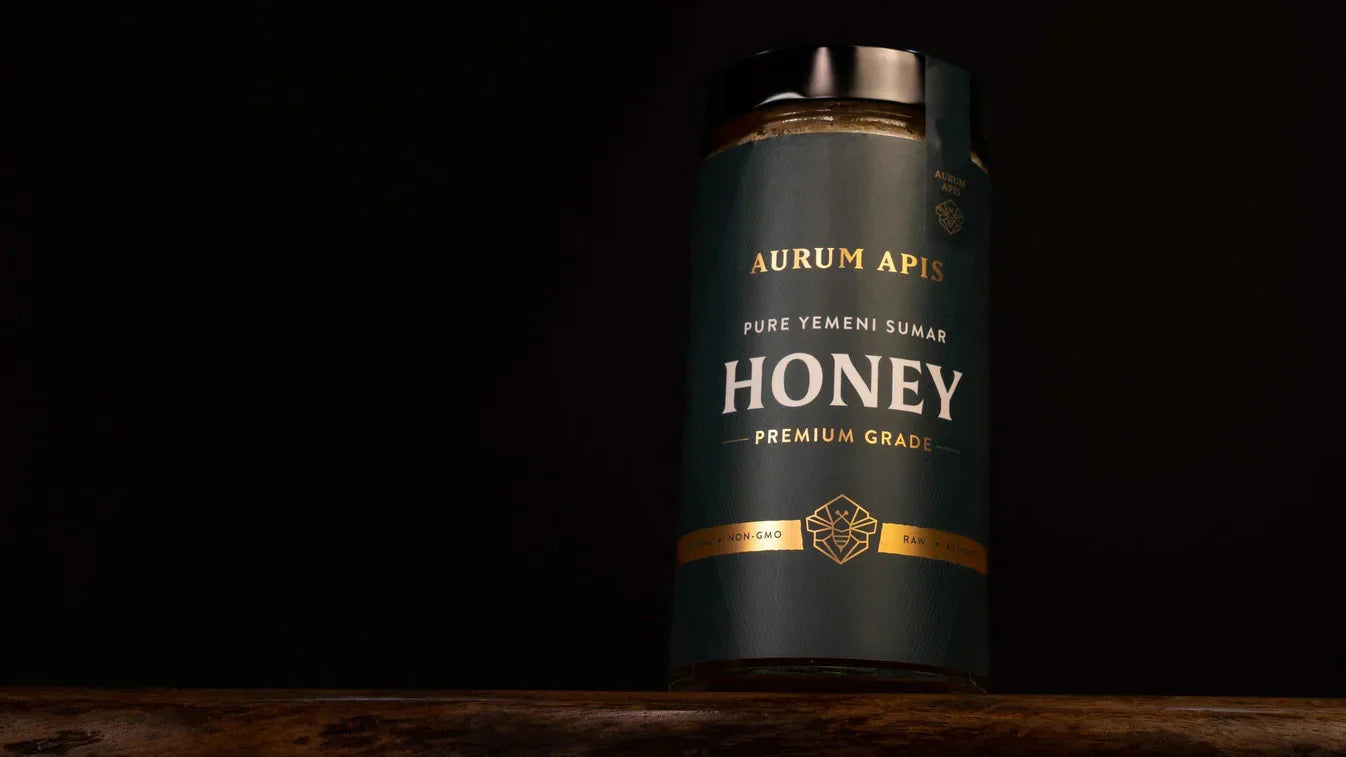
Aurum Apis offers Yemeni Wildflower Honey in 330g, 500g and 1kg sizes, sourced from Yemen and presented as a raw, premium honey.
Final Thoughts
Yemeni Wildflower Honey stands apart from ordinary honey in every meaningful way. It comes from one of the world's most biodiverse highland environments, collected by bees foraging across dozens of rare wildflower species. It is harvested using centuries-old traditional methods that preserve everything modern processing destroys. It reaches you raw, enzyme-rich, antioxidant-dense, and completely free of additives.
Frequently Asked Questions
Is Yemeni Wildflower Honey healthier than regular honey?
Raw Yemeni Wildflower Honey retains live enzymes, antioxidants, natural pollen, and trace minerals that commercial pasteurized honey largely loses during processing. For those seeking the full nutritional value of honey, raw wildflower honey from a biodiverse region like Yemen's highlands is generally considered the superior option by nutrition researchers and natural food specialists.
Why is Yemeni honey considered premium?
Several factors contribute: Yemen's unique highland geography with endemic wildflower species, centuries-old traditional beekeeping methods that avoid industrial shortcuts, small batch cold-press extraction, and a limited seasonal supply that cannot be scaled. The result is a honey with exceptional flavor complexity, biological integrity, and traceable provenance, qualities that genuinely justify a premium price.
Does Yemeni Wildflower Honey contain additives?
Authentic Yemeni Wildflower Honey should contain nothing other than honey. No sugar syrups, preservatives, flavorings, or thickeners. Always purchase from suppliers who provide transparent sourcing information and, ideally, independent laboratory testing to confirm purity.
What does authentic Yemeni Wildflower Honey taste like?
Expect a complex, layered flavor, warm floral sweetness on the front, a light herbal depth in the middle, and a rich, slightly spiced finish. The taste varies subtly with the season and harvest region. It is noticeably more complex and aromatic than typical commercial honey.
How can you tell if Yemeni honey is real?
Key indicators include natural crystallization over time, a thick and viscous consistency, a complex floral aroma, visible pollen particles, and a rich amber to deep golden color. Reputable suppliers provide origin traceability, pollen testing, and clearly label products as raw and unfiltered. Be wary of honey that stays perfectly liquid indefinitely or comes with no sourcing details.
Why does raw honey crystallize?
Crystallization is a natural process driven by the glucose content in honey and the presence of microscopic pollen particles, which serve as seed crystals. Honey that has not been ultra-filtered or heavily processed will almost always crystallize over time. This is a positive sign, not a defect. To re-liquefy crystallized honey, place the sealed jar in warm water for 20–30 minutes; never use boiling water, as it degrades the enzymes.
Is wildflower honey good for daily use?
Yes. One to two teaspoons of raw wildflower honey per day is a widely used approach in wellness routines. It serves as a nutritionally richer alternative to refined sugar in teas, warm water, and foods. As with all sweeteners, moderate daily consumption is recommended as part of a balanced diet.
Can raw wildflower honey support immunity?
Raw wildflower honey contains natural antioxidants, flavonoids, and enzymes that are associated with general wellness support. While honey is not a medicine and should not be used to treat or prevent disease, incorporating raw honey into a balanced diet and healthy lifestyle is a time-honored wellness practice across many cultures, including in Yemen itself.
Where can I buy authentic Yemeni Wildflower Honey in the UAE?
Look for specialist honey retailers, authentic Yemeni product importers, and premium natural food stores that provide clear sourcing documentation. Online platforms serving the UAE market increasingly carry certified raw Yemeni honey, always prioritize suppliers who can confirm the geographic origin, raw extraction method, and ideally third-party purity testing for the product you are purchasing